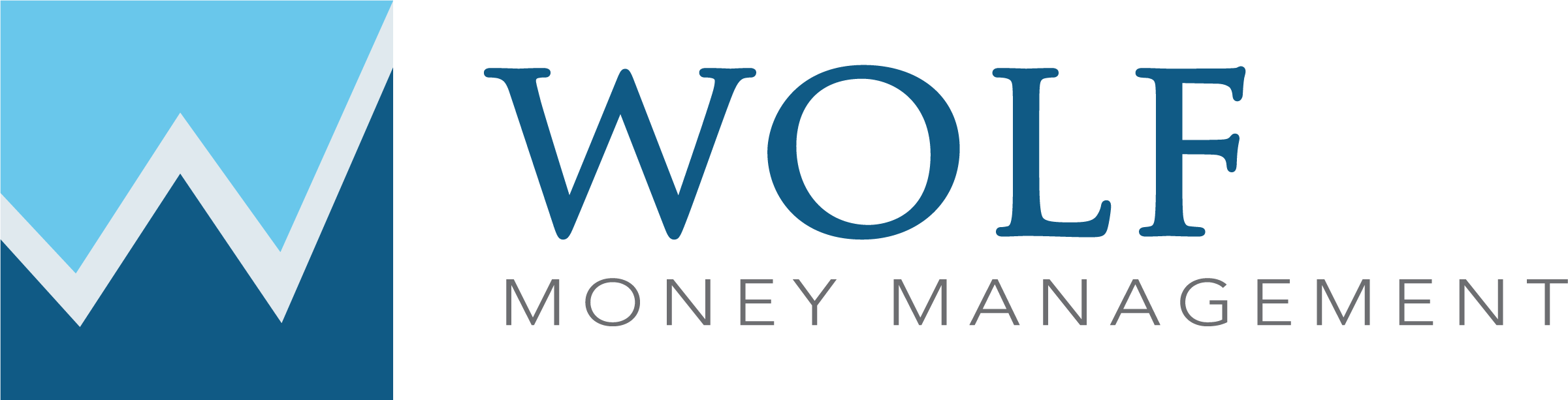

If nothing else, markets kept us entertained last week. The S&P 500 was higher four out of five days, but the down day was big as markets tested recently minted Fed Chair Kevin Warsh. U.S. stocks tanked after the Federal Reserve didn’t say much on Wednesday, but most of the losses were erased in a huge Thursday surge thanks to some major support from earnings during the most important reporting week of the quarter. Overseas, the show was even wilder: South Korea’s KOSPI, which had crashed 44%, soared a record 17% on July 31—and still finished the week down 2%.
When the dust settled, the S&P 500 ended July slightly lower for a second straight down month, even as it sits only about 2% from all-time highs, while long-term Treasury yields surged, with the 30-year yield hitting its highest level since 2007. Putting it all in context, we believe our Midyear Outlook 2026: Still Riding the Wave remains well in play. This week (and month) showed both why we’re still riding the wave and why it takes genuine situational awareness to continue to ride it while setting yourself up to try to avoid a wipeout.
The opinions contained in this complimentary download is provided entirely on behalf of CWM, LLC and is in no way related to Cetera Wealth Services LLC, or its registered representatives. This information is from sources believed to be reliable, but Cetera Wealth Services LLC cannot guarantee or represent that it is accurate or complete.
Putting It in Perspective
Yes, the S&P 500 finished July lower, but not by much. Of course, this follows a 1% decline in June, so we are looking at two down months in a row. Here’s the catch—and there’s always a catch—the S&P 500 soared nearly 16% in April and May, so maybe some slight giveback isn’t the worst thing. Looking at the chart of the S&P 500, it looks like stocks are simply correcting via time, as the bull catches its breath for the next assault higher.
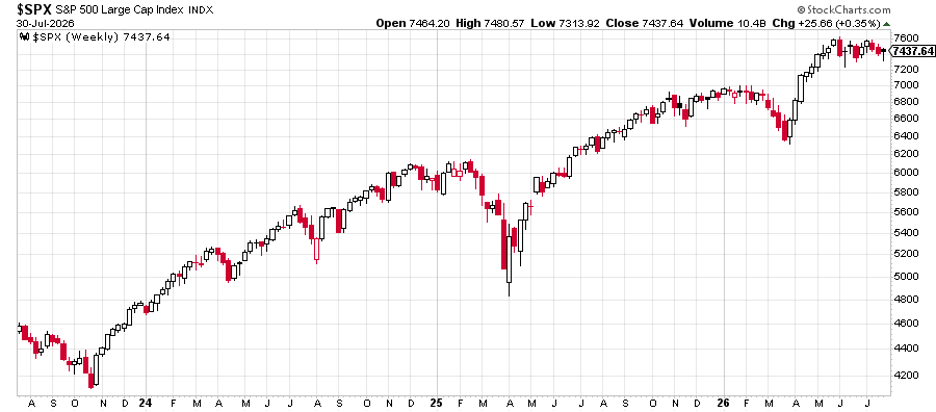
That said, it’s pretty rare for stocks to be lower in both June and July. Some of the worst years in history—including 1974, 1990, 2001, 2002, and 2008—share this dubious distinction. When these two months are lower, the rest of the year falls more than half the time, with an average decline of more than 2%. We still see many more reasons than not to remain bullish the rest of this year, but file this one under things to watch.
Beware the Ides of August
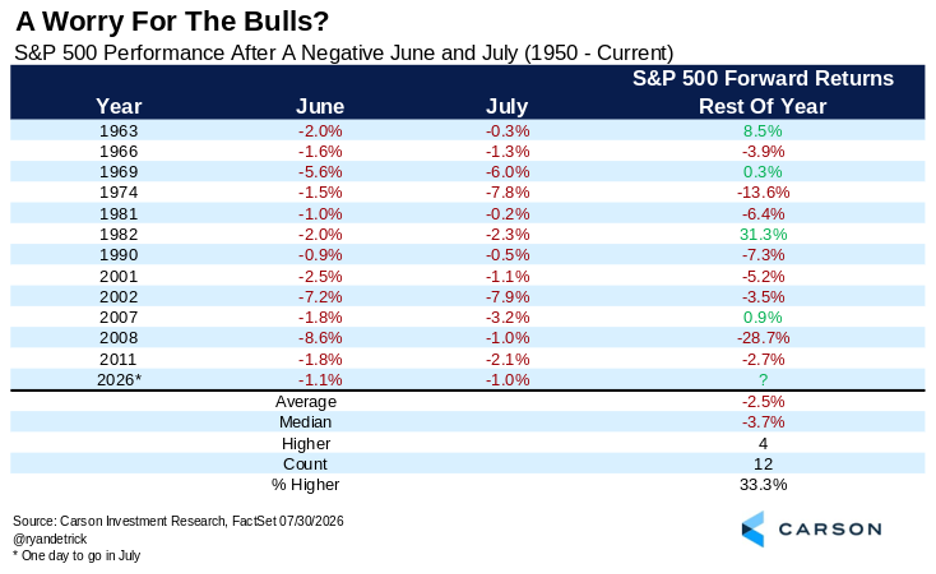
August is the one month of the year that often seems to bring totally out-of-the-blue events that rock markets. No one was talking about the yen carry trade in the summer of 2024, yet by the first Sunday night of August, global markets were crashing and we all became currency experts overnight. (It didn’t last.)
The bottom line is August (and September) can be trouble, or at the very least volatile. We are still in a bull market and still expect higher prices by year-end, but would some usual August/September volatility really be a shock, especially in a midterm year? Probably not, so prepare now for not getting caught up in any overly negative narratives that seasonal volatility might bring.
Here’s Some Good News
We believe there are many reasons to still expect the S&P 500 to gain 15-18% in 2026, as we laid out in our Midyear Outlook. One important piece: Earnings season has been spectacular so far, justifying stocks at these (and likely even higher) levels.
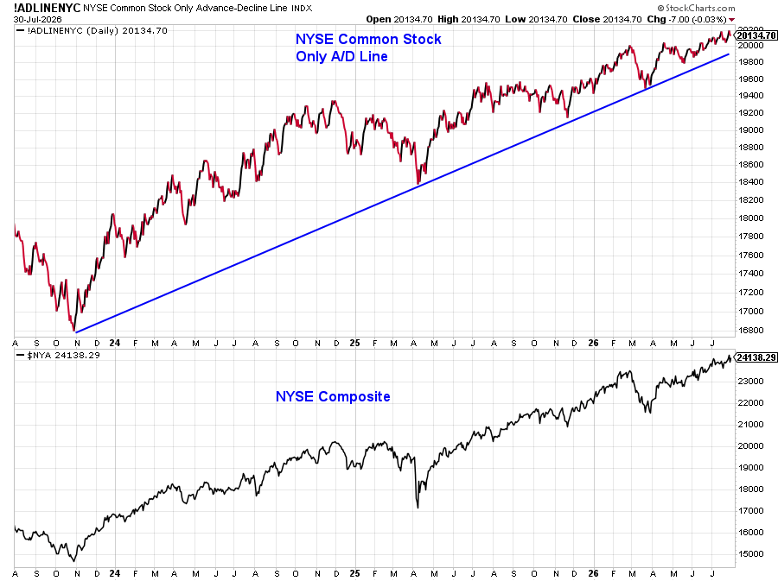
Another positive we’re watching is market breadth, one of our favorite technical indicators. If many stocks are participating in the rally, it’s a sign the bull is on firm footing. Last week, the NYSE common stock only advance/decline line—a cumulative tally of how many stocks go up versus down each day—hit an all-time high. Market breadth leads price, so count a new high in breadth in this very broad-based index as one piece of evidence for prices moving higher. Not to be outdone, the S&P 500’s advance/decline line also hit a new high last week.
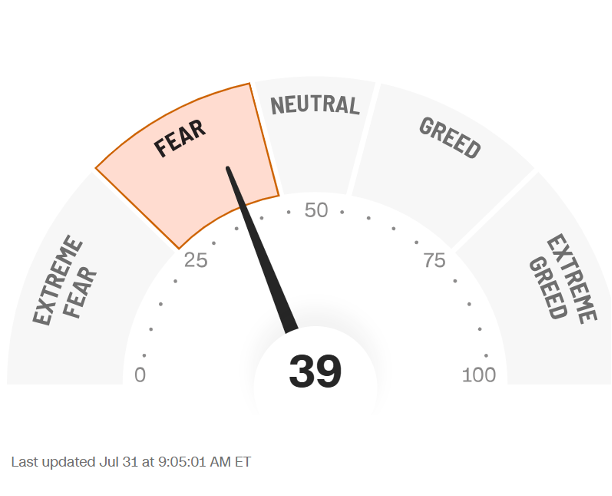
More good news if you look under the hood: Sentiment, where bad news is often good for markets, remains negative. Most individual investors have been quite shaken by the AI/semiconductor/momentum crash in July. The CNN Fear & Greed Index is firmly in the fear range, while various put/call ratios are showing levels consistent with major lows.
The AAII Sentiment Survey recently registered one of the largest drops in bulls in history (down 15%), and bulls are still only 31%.
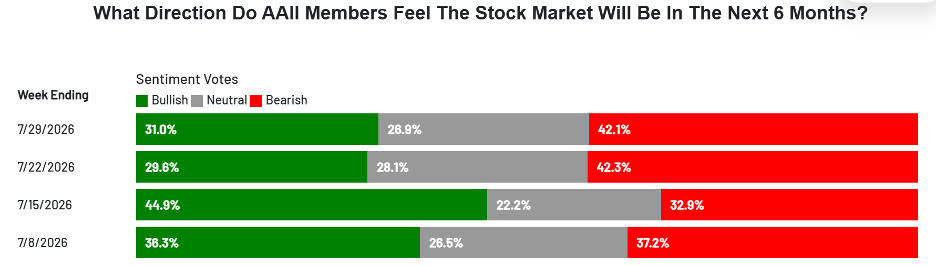
The bottom line: With the S&P 500 about 2% from all-time highs, we are seeing far more worry than you’d expect, which could be quite bullish from a contrarian point of view.
Just Wait
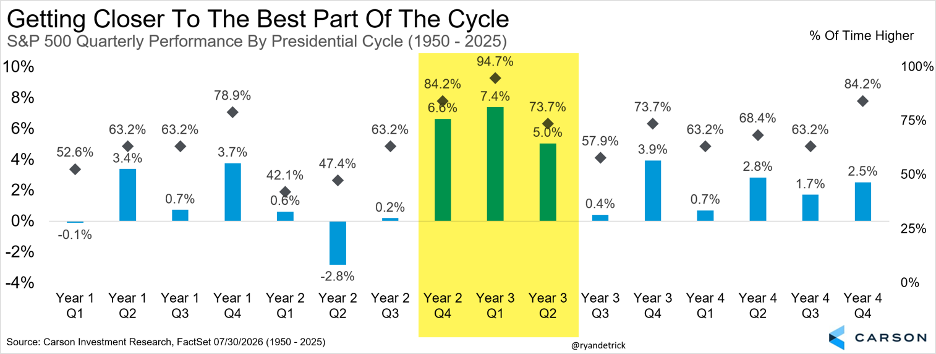
Another potentially positive note: Some of the very strongest quarters of the four-year presidential cycle are just around the corner, beginning in the fourth quarter of the midterm year, which we’re in now. Should we see any seasonal weakness in the coming months, don’t panic—better times are likely coming.
Markets Tend to Test a New Fed Chair
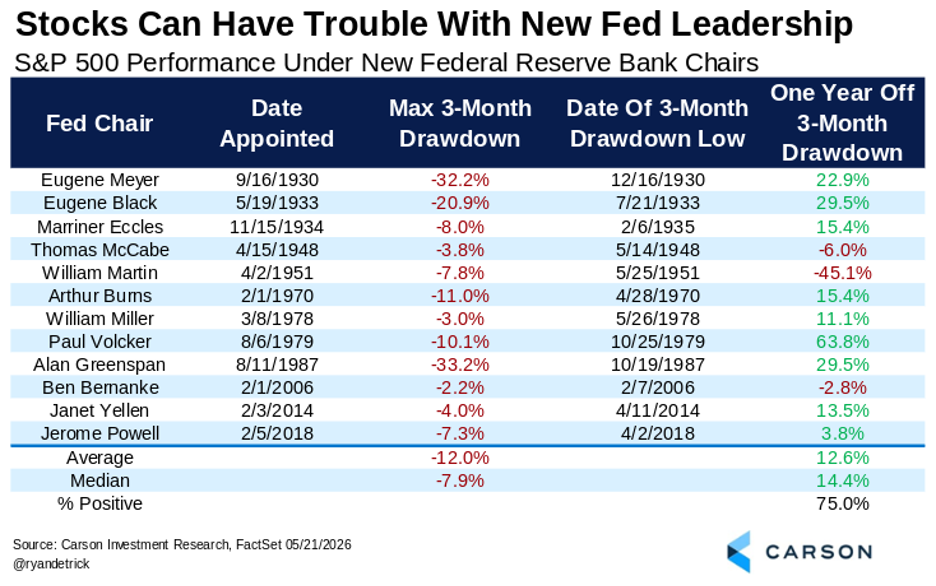
As we discussed in our Midyear Outlook, markets have a funny way of testing new leadership at the Federal Reserve. Things have gone OK since Warsh took over, but the S&P 500 did drop more than 1% at each of his first two Fed meetings.
The real test may be coming from the bond market, with yields soaring and the 30-year yield at its highest level since 2007—but a test from stocks wouldn’t be a surprise either. Early in a new Fed chair’s tenure, equity weakness is common.
So what exactly did the Fed do—or not do—to spark all this? Let’s dig in.
The Fed Stands Pat, but the Committee Isn’t United
Fed Governor Chris Waller recently said that sternly staring at inflation until it melts before our withering gaze is not an option. Yet that appears to be exactly what the Fed plans to do.
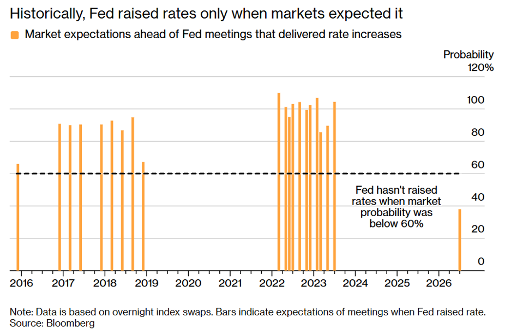
The Fed kept rates unchanged at its July meeting in a 9-3 vote, with three dissents showing the committee is not united behind the inflation staredown. Markets had priced a 30-40% chance of a hike, creating the largest gap between expectations and the decision since September 2024, when the Fed cut 0.50 percentage points. Historically, the Fed has raised rates only when the pre-meeting probability was at least 60%.
So, the decision itself wasn’t a surprise—that was our expectation all along. Almost everything else was.
Optimism, but Why?
The committee, especially Warsh, sounded highly optimistic about an economy it says is expanding at a solid pace on the back of strong productivity growth and capital investment, along with job gains keeping up with the workforce.
Yet real (inflation-adjusted) GDP grew at a measly 1.5% annualized pace in the second quarter, partly because of weaker net exports and an inventory pullback. Over the past six quarters, growth has averaged just 1.9%, below the 2010-19 trend of 2.4% and the 2.9% pace in 2023-24. That does not indicate a strong productivity environment. Even with zero labor force growth, productivity would be about 2%; with hours worked rising, it is closer to 1.5%, matching the relatively weak 2005-22 pace.
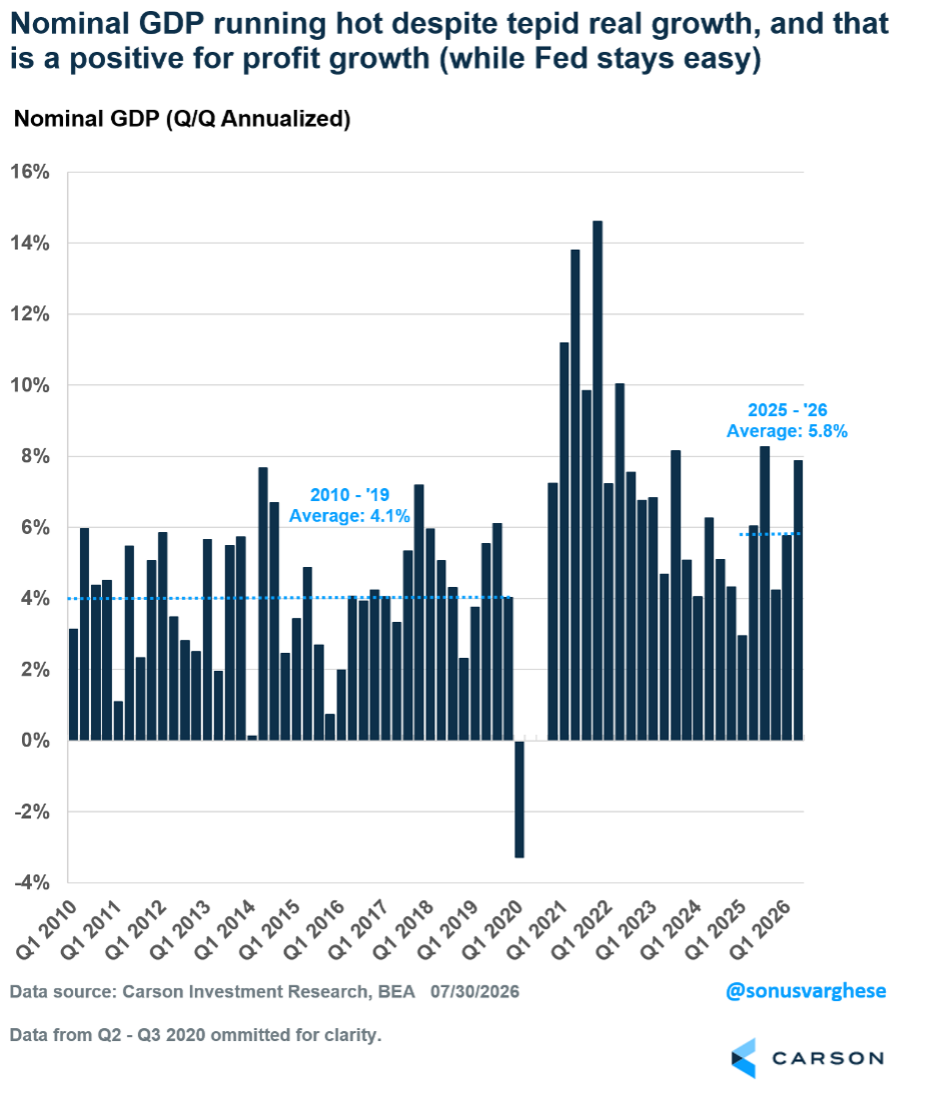
Meanwhile, nominal GDP is running hot: 7.9% annualized in the second quarter and 5.8% over the past six quarters. That is well above the 2010-19 trend of 4.1% and slightly above the 5.6% pace in 2023-24, when real growth was stronger and inflation was easing. As we discussed in our 2026 Outlook and Midyear Outlook, this is inflationary growth, which can be good for companies because revenues and profits come from nominal spending.
Inflation Remains a Problem
Inflation remains elevated and broad-based, with pressure from Middle East bottlenecks, AI-related constraints, tariffs, and core services excluding housing. It’s not just oil prices.
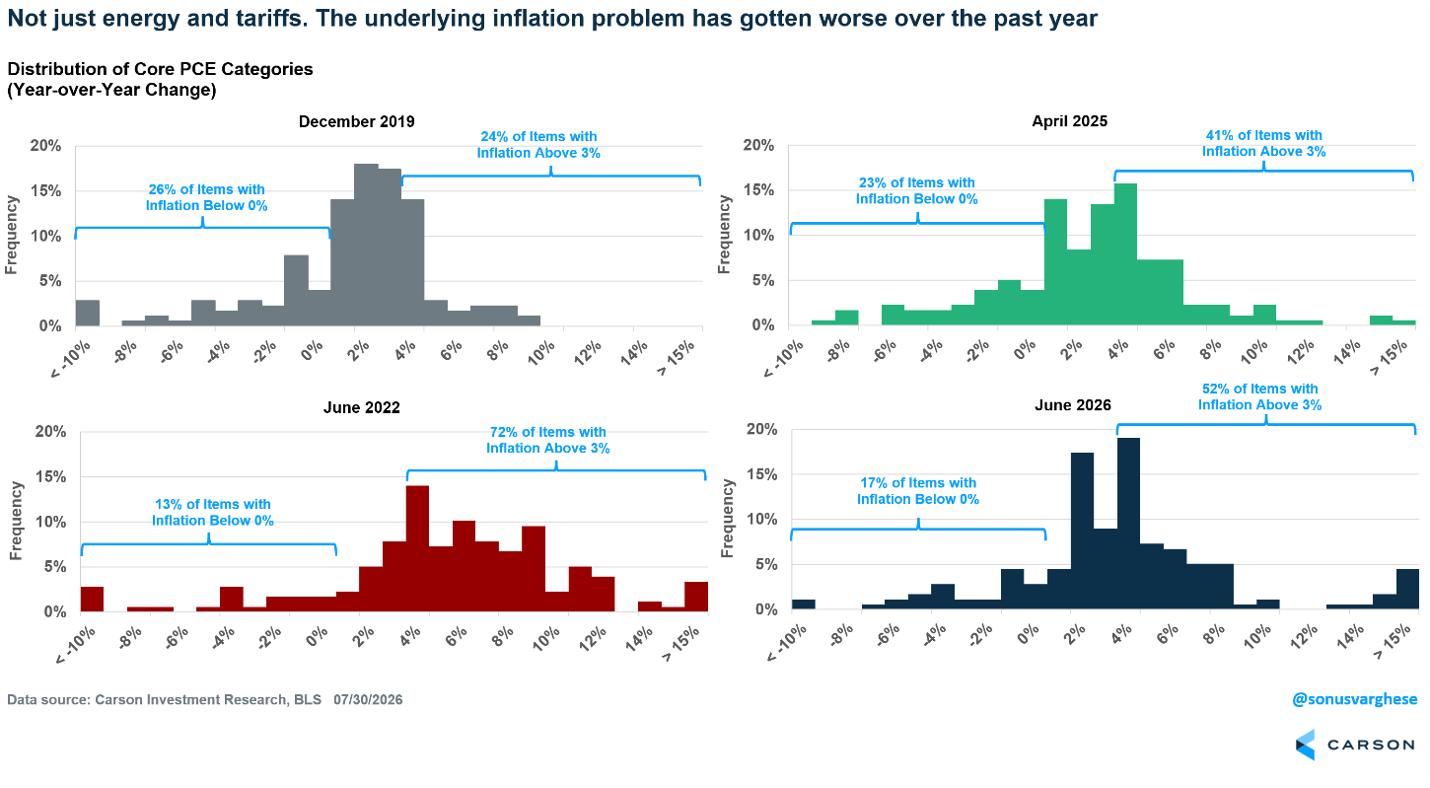
The Fed’s preferred inflation gauge, the core Personal Consumption Expenditures Price Index (PCE), rose just 0.1% in June. But much of the softness came from idiosyncratic price declines that are unlikely to persist. Looking across 178 core PCE items, inflation broadened dramatically by June 2022, narrowed through last year without returning to normal, and has worsened again since April 2025 (post-Liberation Day). The share of items with inflation above 3% (and above 4% in parentheses) shows the shift:
- December 2019: 24% with 3%+ inflation (10% with 4%+ inflation)
- June 2022: 72% (58%)
- April 2025: 41% (25%)
- June 2026: 52% (33%)
A Fed Chair Looking for Reasons (Excuses?) To Be Dovish
In the eight weeks since Warsh became Fed chair, he has repeatedly said the Fed remains committed to its 2% inflation target, including at this meeting’s press conference. But saying it is one thing—explaining how to achieve it is another. Warsh’s press conference lasted 45 minutes, but he managed to say a lot without saying much at all.
At the margin, his comments veered dovish, as he appeared to be looking for reasons not to hike:
- He downplayed AI-related price pressures, saying strong capital spending prepares the ground for future growth (and supply).
- He attributed the recent rise in market rates to economic strength rather than to expectations that the Fed would respond to elevated inflation.
- He suggested higher market rates could substitute for a Fed hike, saying, “rates are higher today since markets have made decisions.”
- He favored lowering inflation through a credible commitment to the target, and lower inflation expectations, rather than by raising rates to reduce demand.
- He implied the Fed could eventually use a broader set of inflation measures instead of PCE, which would further obfuscate the framework.
All this is puzzling. There is no sign AI-related price pressure will ease soon. Think of an AI agent as another worker in the economy: If AI raises productivity, replaces some workers, and accelerates innovation, the amount of work (and the price of AI) could rise. In a strong economy, labor costs also rise, but faster wage growth supports demand and can require higher rates to contain inflation. Unlike technologies that produce disinflation, AI could instead generate inflationary growth.
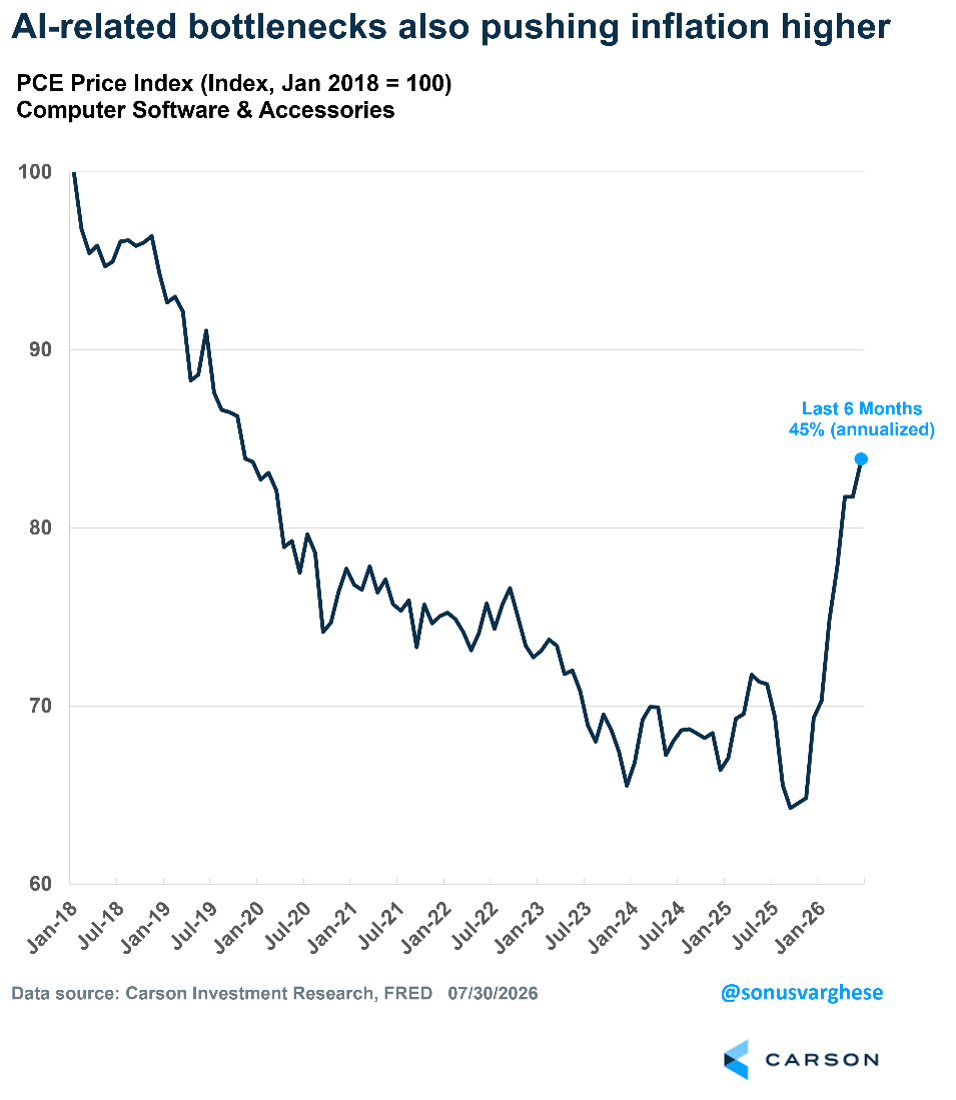
There is no certainty, but the current evidence points to inflation from AI bottlenecks. The PCE price index for computer software and accessories is up 45% annualized this year, reversing six years of price declines in six months. Companies are also spending heavily on AI capital projects, with uncertain returns and higher hurdles, which argues for a higher cost of capital and higher interest rates.
Warsh also appears to be kicking the can down the road, waiting until year-end for committees to propose alternatives to rate hikes, such as using the balance sheet or inflation expectations, and/or a broader set of inflation measures.
Most confusing was his suggestion that the recent rise in market interest rates has done the Fed’s job for it. Short-term rates actually fell after the meeting, reflecting the dovish bias (the one-year yield dropped to 4.0%), while longer-term yields surged.
Asked why policy rates should not be higher, Warsh said he would not describe the decision as a pause. In his view, the long end of the yield curve has done the Fed’s work, and he added, “We’re trying not to interfere with that market signal.”
This makes little sense to us. Short-term rates fell because markets expect a more dovish Fed in the near term. That increases the risk that inflation worsens and the Fed eventually has to act, which is why long-term rates jumped:
- The 10-year yield hit 4.70%, close to the highest level we’ve seen since January 2025.
- The 30-year yield hit 5.23%, a 19-year high.
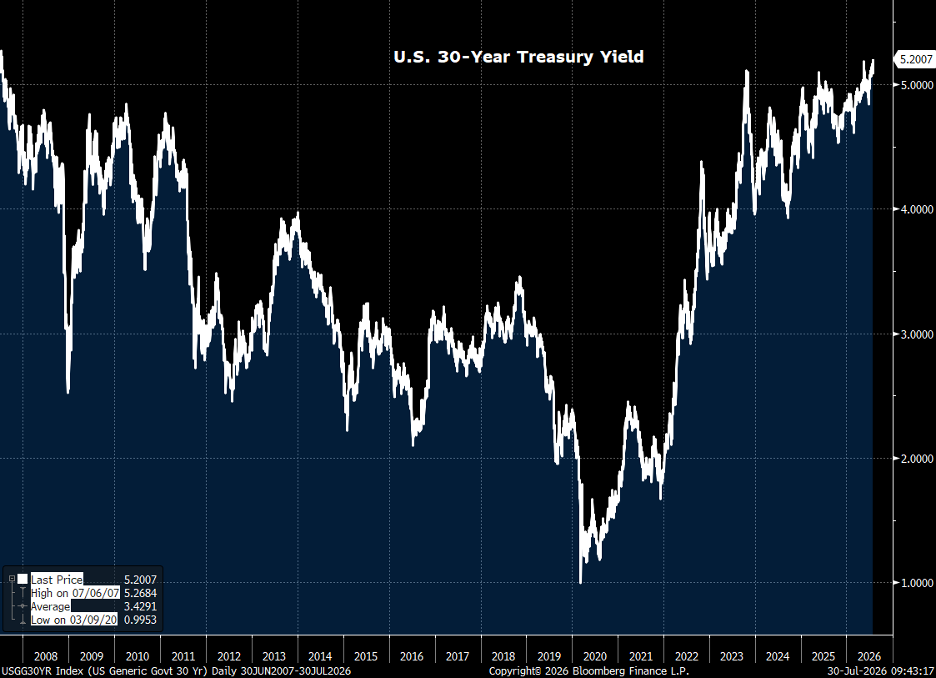
Long-term rates are rising because markets expect more inflation and, eventually, a more hawkish Fed. Saying those higher yields are doing the Fed’s work is perplexing. The Fed is effectively pushing them higher by signaling a willingness to tolerate a hotter economy and more inflation in the near term.
This is also implicit forward guidance, whether Warsh calls it that or not. Markets cannot ignore the Fed, because expectations for policy are central to Treasury pricing. Warsh said the market is finally responding to the data rather than the Fed, but the post-meeting bond moves suggest otherwise. Uncertainty also remains high: Markets now assign a 62% probability to a September hike—roughly speaking, a coin toss. We are heading into the September meeting with almost as much uncertainty as this one. That means we will keep talking about the Fed, whether Warsh wants us to or not.
S&P 500 — A capitalization-weighted index of 500 stocks designed to measure performance of the broad domestic economy through changes in the aggregate market value of 500 stocks representing all major industries.
The NASDAQ 100 Index is a stock index of the 100 largest companies by market capitalization traded on NASDAQ Stock Market. The NASDAQ 100 Index includes publicly traded companies from most sectors in the global economy, the major exception being financial services.
The views stated in this letter are not necessarily the opinion of Cetera Wealth Services LLC and should not be construed directly or indirectly as an offer to buy or sell any securities mentioned herein. Investors cannot invest directly in indexes. The performance of any index is not indicative of the performance of any investment and does not take into account the effects of inflation and the fees and expenses associated with investing.
A diversified portfolio does not assure a profit or protect against loss in a declining market.
All investing involves risk, including the possible loss of principal. There is no assurance that any investment strategy will be successful. This information is from sources believed to be reliable, but Cetera Wealth Services, LLC cannot guarantee or represent that it is accurate or complete.
9055128.1-0826-C
